Satsuma Ware: Kagoshima's White and Black Ceramics
On this page
The crackle of ivory glaze, the glint of gold—this is the face of Satsuma ware the world came to know. But beneath that ornate surface lies a quieter story, one that begins not with luxury but with displacement, and not in Japan but across the sea in Korea.
A Lord's Homecoming and a Potter's Exile
In 1598, as Toyotomi Hideyoshi's Korean campaigns drew to a close, the Satsuma domain lord Shimazu Yoshihiro returned to southern Kyushu with an unusual retinue: some eighty Korean potters. Among them was Chin Jukan (born Sim Dang-gil in Korea), whose descendants would carry his name and craft through fifteen generations. The potters settled in Naeshirogawa, in what is now Miyama, Hioki, Kagoshima—a forested valley far from the battlefields that had uprooted them. Here, they would lay the foundations of a ceramic tradition that would one day dazzle Vienna.
Two Faces of Satsuma
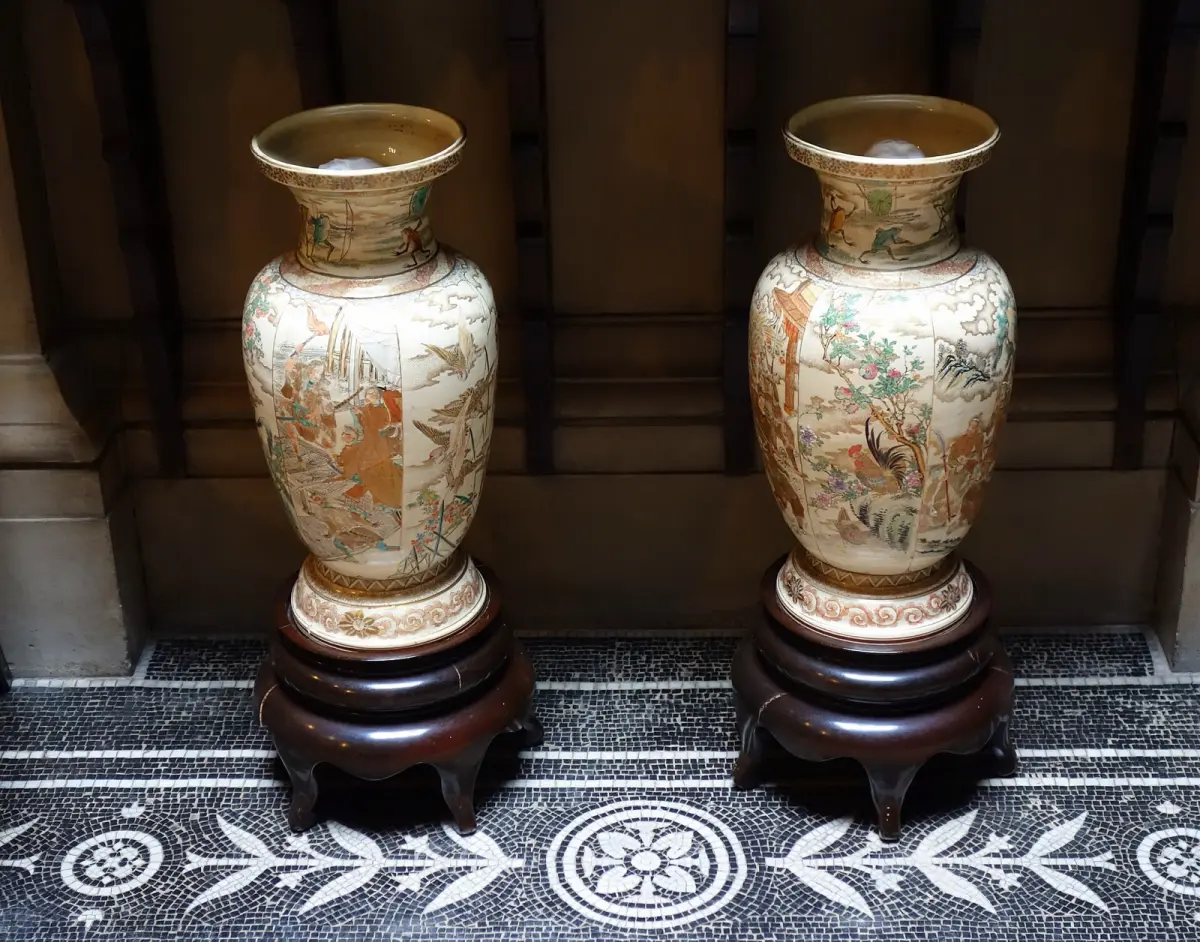
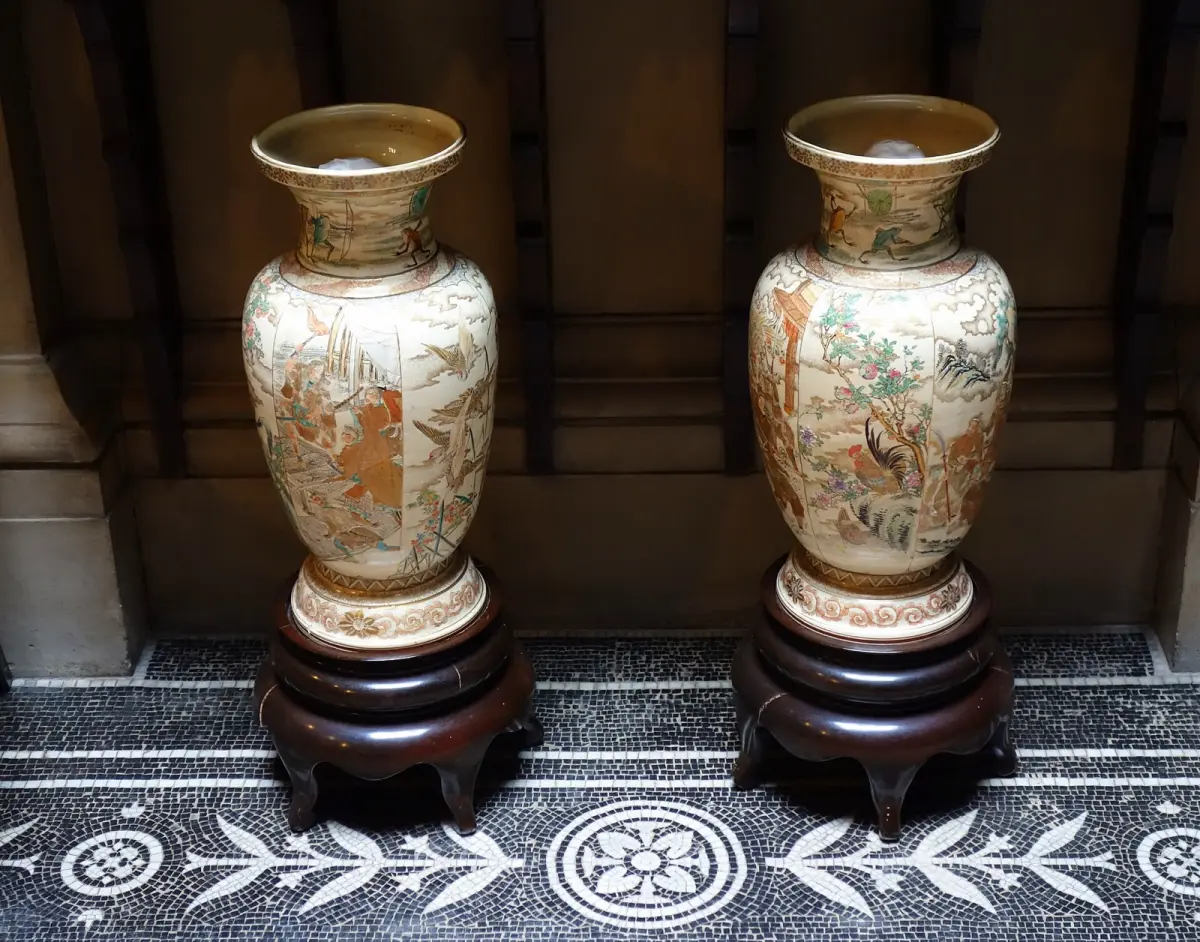
When white clay deposits were discovered near Naeshirogawa, the potters' work split into two distinct streams. Shiro-Satsuma (白薩摩, 'white Satsuma') became the refined ware of the ruling class—finely crackled ivory vessels painted in overglaze enamels of gold, red, green, purple and yellow. This was pottery as courtly art, made for lords and dignitaries.
But the Korean potters also produced kuro-Satsuma (黒薩摩, 'black Satsuma'), the sturdy, dark-glazed kuromon that served everyday needs. These were the bowls and bottles of common life, unadorned but honest. The two traditions existed side by side, one for ceremony, one for sustenance—a duality that speaks to the potters' dual role as both artisans and immigrants building a new life.
The Vienna Moment
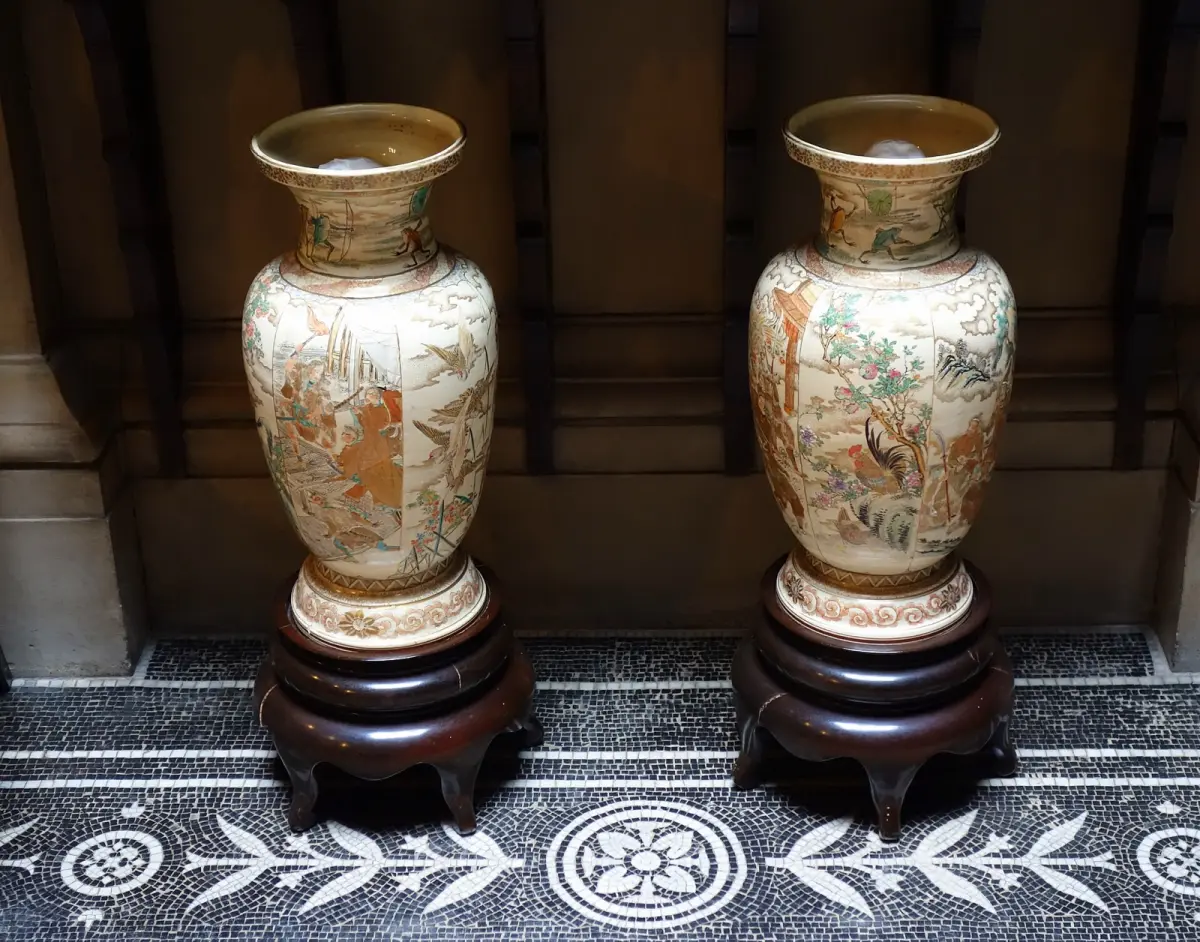
For more than two centuries, Satsuma ware remained largely a regional craft. Then came 1873 and the Vienna Exposition, where the twelfth-generation Chin Jukan exhibited a magnificent pair of vases. The response was immediate and overwhelming. European and American audiences, hungry for japonisme, fell for the intricate gold-painted designs and delicate crackle glaze. 'SATSUMA' became a byword for Japanese decorative ceramics, its name stamped on export wares produced far beyond Kagoshima. Ironically, the style's international fame would eventually obscure its origins, as imitators proliferated and the word 'Satsuma' became more brand than place.
Miyama's Quiet Continuity
Today, the village of Miyama in Hioki remains the heart of authentic Satsuma production. A dozen or so kilns still fire here, including the Chin Jukan kiln, now in its fifteenth generation—a living link to that first displaced potter who arrived in 1598. Walk through Miyama and you'll find workshops where the old techniques persist: the careful application of overglaze enamels, the controlled firing that produces the characteristic crackle, the balance between restraint and decoration.
The Chin Jukan lineage represents one of the longest unbroken pottery traditions in Japan, a testament to both craft mastery and cultural resilience.
The kilns here produce both traditional forms and contemporary interpretations, honouring the dual heritage of shiro and kuro, ornament and utility.
Crackle as Memory
That fine network of lines crossing a Satsuma surface—the kannyu crackle—is more than decorative effect. It's a record of tension and release, of glaze and clay cooling at different rates, of controlled imperfection made beautiful. Perhaps it's fitting that a craft born of rupture and resettlement should be known for its cracks, each piece carrying a map of invisible stresses transformed into pattern.
Four centuries on, Satsuma ware endures in the valley where Korean hands first shaped Kyushu clay—a craft that never forgot it came from elsewhere.
Chaware curates authentic Japanese crafts — straight from the makers in Japan to your table.
Explore the Chaware collection →
Keep exploring