Tokyo Silver: The Edo Silversmith's Craft
On this page
Article Body
In the quiet workshops of Taito and Arakawa, hammers tap a rhythm unchanged for centuries. Here, Tokyo's silversmiths still coax metal into forms of such restrained brilliance that light itself seems to pause on their surfaces—a legacy born when Edo's prosperity first allowed ordinary townsfolk to own beauty wrought in silver.
The Shimmer of Edo Prosperity
Tokyo ginki (東京銀器) traces its lineage to the mid-Edo period, roughly between 1650 and 1750, when the city then known as Edo swelled with commerce and ambition. As the economy flourished, a new class of artisans—shirogane-shi silversmiths—gathered in the bustling capital, their workshops clustering in neighbourhoods where metal rang against metal from dawn to dusk. What had once been the exclusive province of samurai and nobility began to trickle into the homes of prosperous merchants and townsfolk: silver ornaments, tableware, objects that married function with quiet prestige.
This was silver for a society finding its aesthetic voice, shaped by hands that understood restraint as the highest form of expression.
Paris and the World's Gaze
The craft's refinement did not go unnoticed beyond Japan's shores. At the 1867 Paris Exposition, Japanese silverwork seized international attention, its forms and techniques a revelation to Western eyes accustomed to different traditions of ornamentation. The pieces displayed there spoke a visual language at once foreign and utterly compelling—proof that Tokyo's silversmiths had achieved something singular. That recognition helped cement the craft's reputation, even as Japan itself stood on the threshold of profound transformation.
Three Techniques, One Vision
Tokyo ginki rests on three pillars of technique, each demanding years to master:
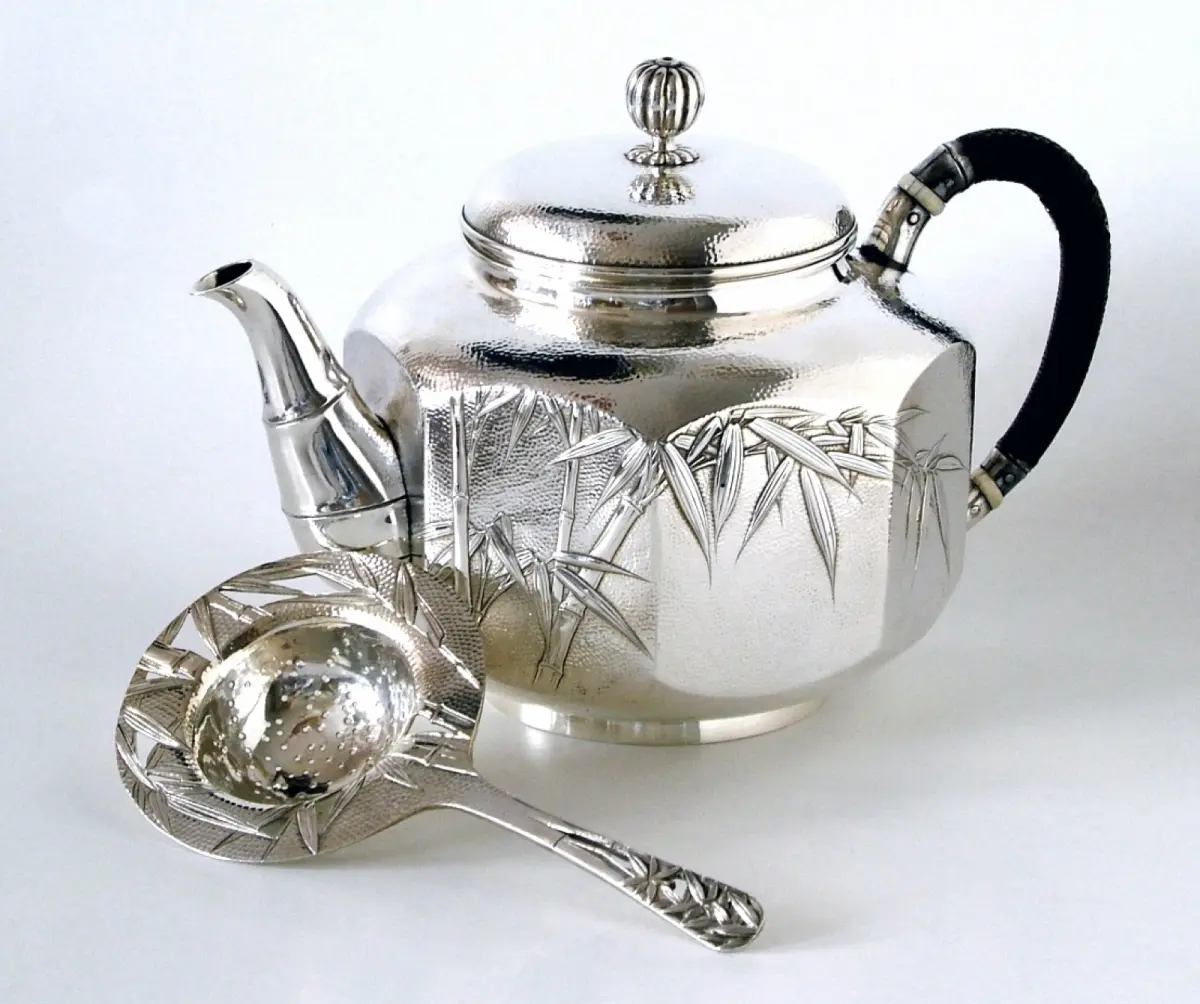
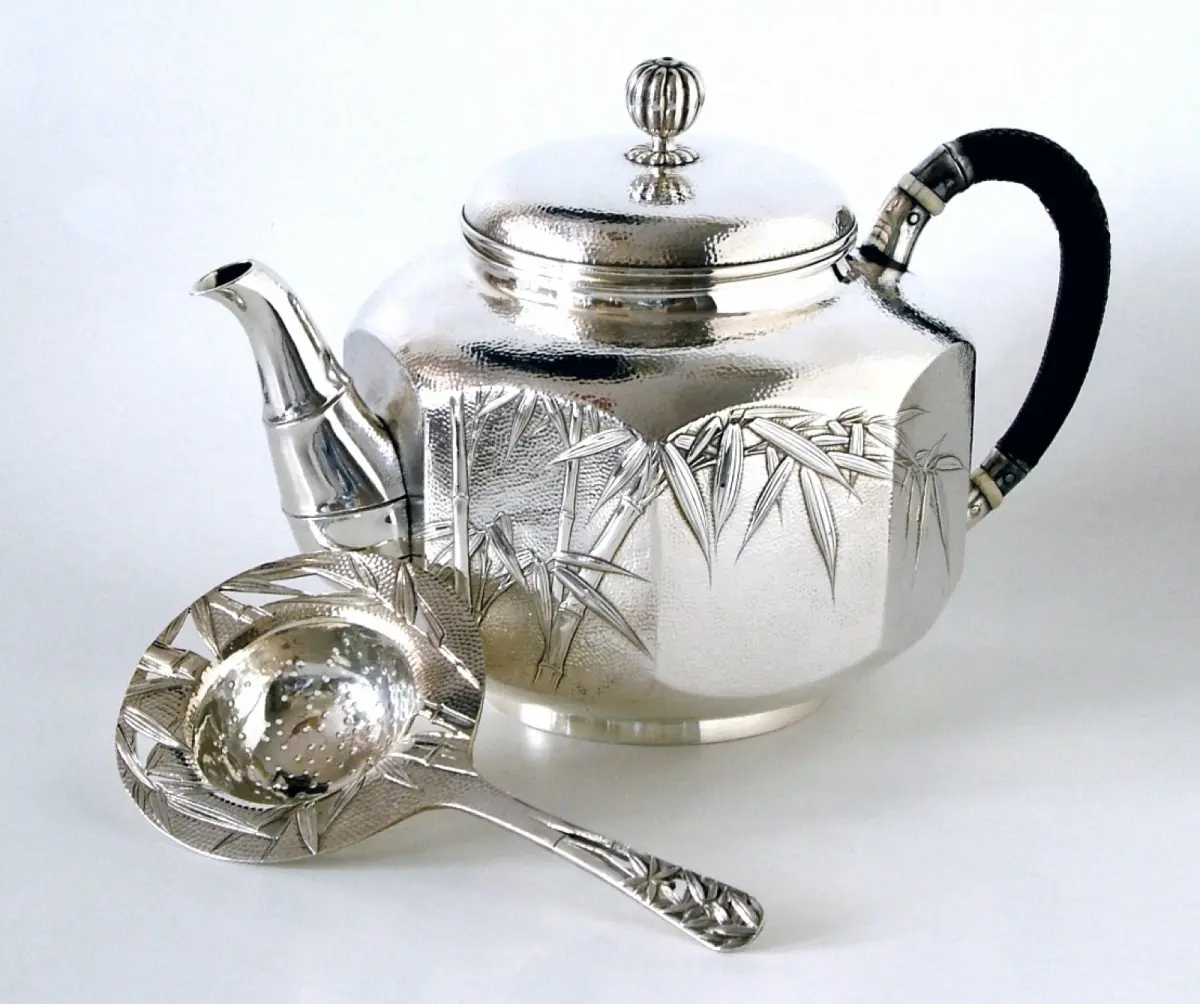
Tankin (鍛金) is the art of raising—hammering flat silver sheet over anvils and stakes until it swells into three-dimensional form. A sake cup begins as a disc; through thousands of carefully placed blows, it becomes a vessel.
Chokin (彫金), the chasing and engraving of decoration, adds surface life. Here the silversmith becomes calligrapher and painter both, cutting or embossing patterns that catch and release light. The restraint is crucial: too much decoration overwhelms; too little leaves the piece mute.
The final stage is finishing—polishing, patinating, bringing forth the metal's inherent lustre. Almost all of this work happens by hand, the maker's touch present in every facet. Machines cannot replicate the subtle irregularities that give each piece its particular presence, the faint evidence of human attention.
Objects of Weighty Brilliance
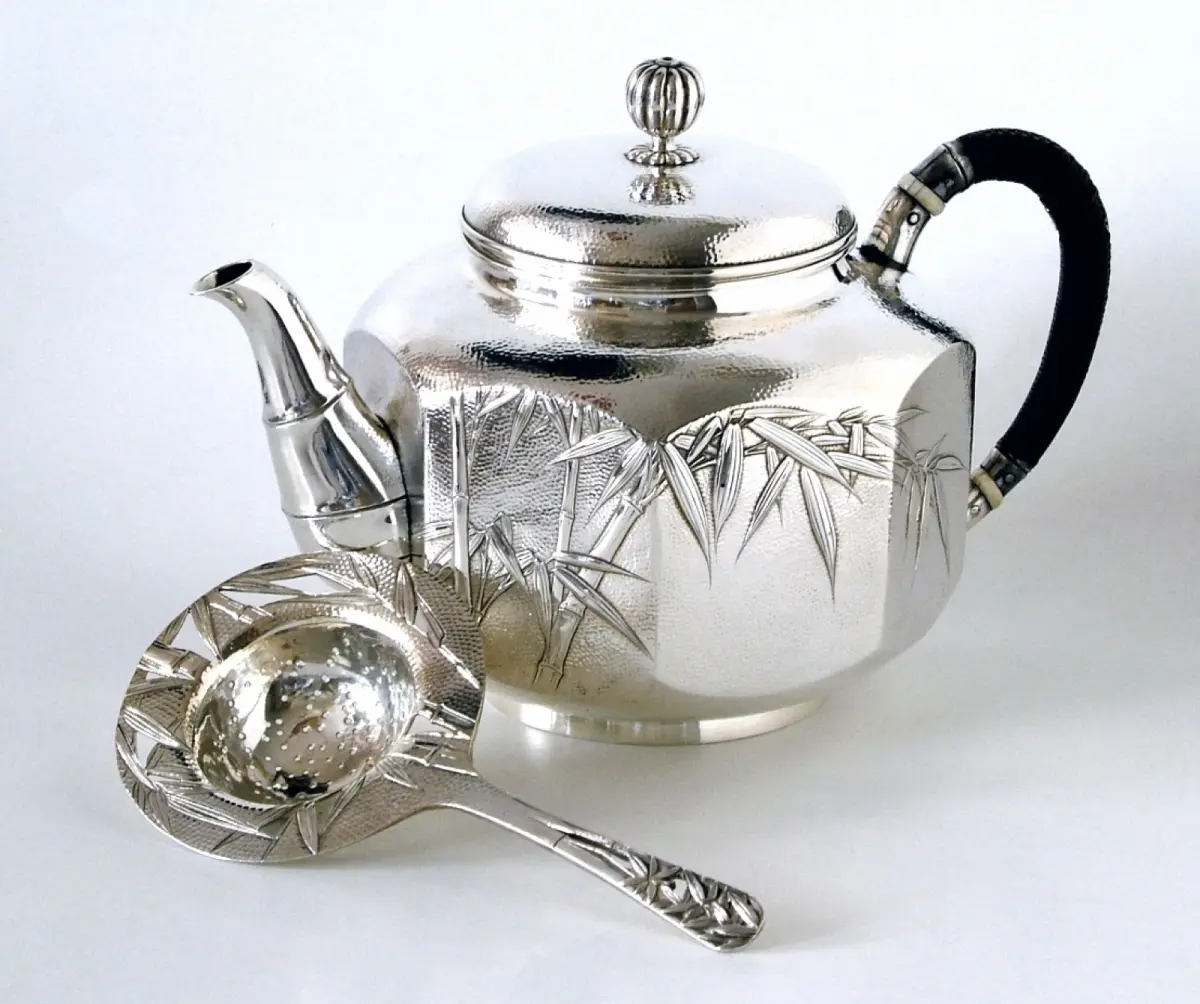
What emerges from these workshops are cups, vessels, cutlery, and tea utensils marked by what might best be called weighty brilliance. The silver itself has heft, substance; these are not delicate confections but objects built to be used, to acquire the patina of daily ritual. A tea caddy sits solidly in the palm. A sake cup has balance, its rim finished to a thickness that feels right against the lip.
The aesthetic leans toward restraint rather than ostentation—surfaces may be plain or bear minimal decoration, allowing the quality of the metal and the precision of the form to speak. This is silver that whispers rather than shouts, that rewards sustained attention rather than demanding immediate admiration.
Living Tradition in Modern Tokyo
Recognition came officially in 1979, when Tokyo ginki received designation as a national Traditional Craft. The designation acknowledges not just historical significance but ongoing vitality—these techniques continue in the hands of contemporary makers working in Taito and Arakawa, the same districts where their predecessors gathered centuries ago.
The workshops remain small, often family operations where knowledge passes directly from master to apprentice. The pace is deliberate, measured in the time required to truly understand silver's character, to know how it responds to heat and pressure, when to anneal and when to strike. In an age of rapid production, these silversmiths maintain a different relationship with time.
Silver shaped in Tokyo still carries the weight of all those hands, all that patient attention—objects made not for the moment, but to outlast it.
Chaware curates authentic Japanese crafts — straight from the makers in Japan to your table.
Explore the Chaware collection →
Keep exploring